
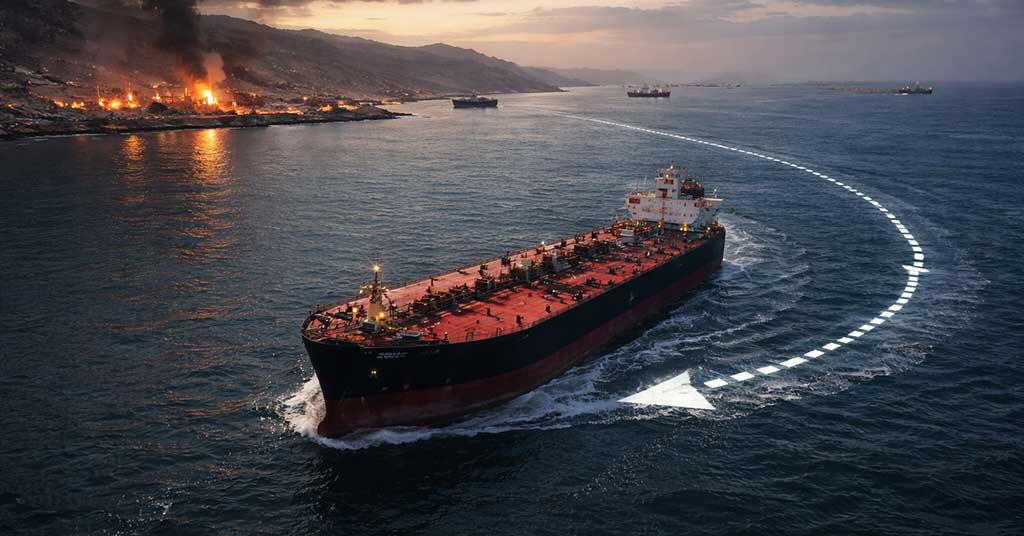
The Hormuz crisis has broken global trust, leaving buyers desperate for reliable partners

The Strait of Hormuz crisis is exposing how unreliable Middle East energy supply has become and has opened the door for countries like Canada to fill the gap.
Roughly 20 per cent of global crude and 30 per cent of liquefied natural gas move through that narrow channel each year. It is the main export route for producers such as Saudi Arabia, Iraq and Qatar. When the channel shuts down, the conversation shifts from price swings to whether the Middle East can be trusted as a supplier at all.
That is why this moment feels different. Previous crises in the Middle East pushed prices higher, then settled. Supply resumed and markets carried on. This time, it is about whether relying on the Persian Gulf still works. That is a much bigger shift, and it carries real consequences.
If buyers decide the region carries ongoing geopolitical risk, they will not wait for the next disruption. They will start buying from different countries, signing long-term supply deals and investing in more stable regions.
That is how energy markets reset, not with announcements, but with decisions made quietly and quickly.
So if the world starts looking elsewhere, where does that supply come from? Canada is in the mix, but it is not alone, and others are already ahead.
On paper, Canada looks ready. It has the reserves and growing export capacity through the Trans Mountain pipeline and LNG Canada. More infrastructure is coming online, including the Ridley Island Energy Export Facility, and other projects are already approved.
But paper does not move barrels, and it does not ship gas.
Every time global markets tighten, Canada gets mentioned as part of the solution, and every time, it fails to deliver in meaningful volumes.
The problem has never been what is in the ground. It is whether Canada can get it to market in time, and it has consistently fallen short of doing so. Canada still sends the vast majority of its oil exports to the United States, with limited access to overseas markets.
That matters now because the window to secure long-term supply deals is closing faster than usual.
If buyers conclude Middle Eastern supply cannot be relied on, they will not wait for Canada to catch up. They will lock in supply elsewhere. The United States, Australia and others are already positioned to move quickly. The U.S. is now the world’s largest oil producer and a major LNG exporter, while Australia is already one of the leading LNG suppliers to Asia.
Energy markets do not reward hesitation. They replace it.
There are already signs of how quickly things can shift. Reports of damage to infrastructure at Qatar’s Ras Laffan industrial complex suggest some LNG production has been disrupted, with repairs potentially taking significant time.
Canada could help fill part of that gap. Federal officials have suggested the country could eventually export up to 100 million tonnes of LNG annually if planned projects proceed, and British Columbia alone could reach roughly 47 million tonnes by the early 2030s if approved projects are completed.
But those projections are meaningless unless they turn into real supply; the world doesn’t care about our resource potential, it cares about our ability to act.
Energy systems are unforgiving. They reward reliability, speed and scale, and they punish delay.
Only weeks ago, the conversation was about oversupply. That has changed quickly. One disruption, one chokepoint, and the system recalibrates.
That is the lesson coming out of Hormuz.
Markets will not wait for Canada. They will go where supply is reliable and ready. If Canada misses this moment, it will not get another one.
Toronto-based Rashid Husain Syed is a highly regarded analyst specializing in energy and politics, particularly in the Middle East. In addition to his contributions to local and international newspapers, Rashid frequently lends his expertise as a speaker at global conferences. Organizations such as the Department of Energy in Washington and the International Energy Agency in Paris have sought his insights on global energy matters.
Explore more on Energy sector, LNG, Pipelines, Energy security
The views, opinions, and positions expressed by our columnists and contributors are solely their own and do not necessarily reflect those of our publication.
Troy Media empowers Canadian community news outlets by providing independent, insightful analysis and commentary. Our mission is to support local media in helping Canadians stay informed and engaged by delivering reliable content that strengthens community connections and deepens understanding across the country.

