
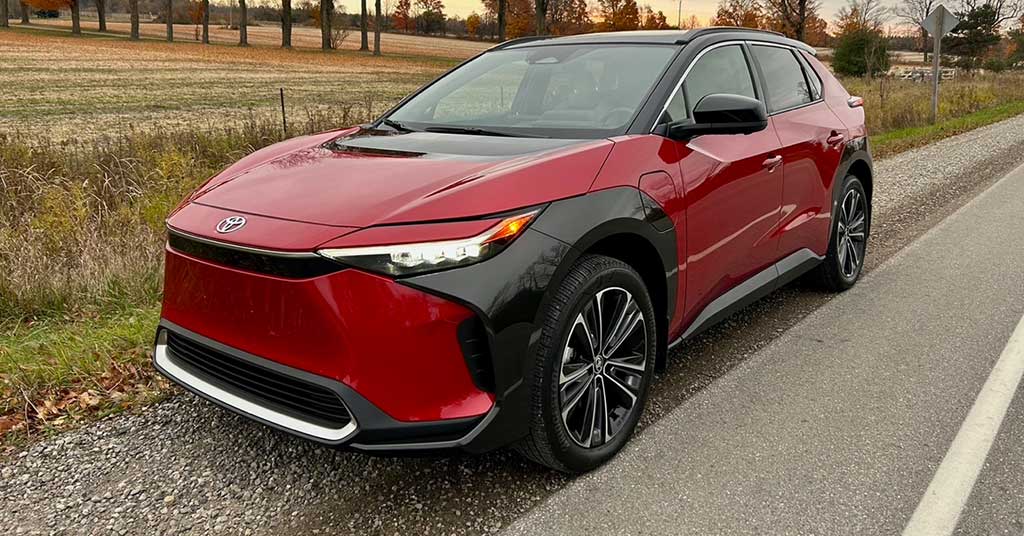
Toyota’s all-electric compact SUV delivers comfort, design and capability but limited availability and quirks may hold it back for now
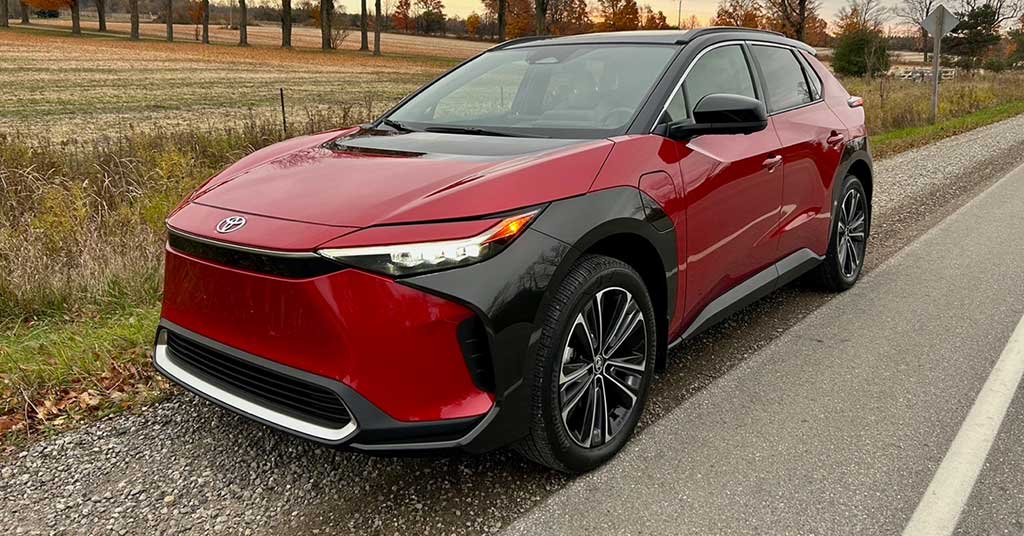
The Toyota bZ4X is built to take on top EVs from Hyundai, VW and Nissan but Canadians outside B.C. and Quebec will have to wait.

Toyota’s first all-electric SUV, the bZ4X, blends bold design, spacious comfort and practical range. But its oddball name, limited availability and a few quirks may keep it from becoming a household name—at least for now.
The bZ4X is a compact, four-door crossover with the Toyota badge and a tongue-twister of a name. “bZ” stands for “beyond Zero,” a nod to zero emissions. The “4” matches its RAV4-sized footprint. And “X” signals it’s a crossover.
This is Toyota’s first fully electric vehicle, co-developed with Subaru (which sells it as the Solterra). While Toyota has led the hybrid market for over two decades, this marks its jump into the growing EV arena.
Currently sold only in B.C. and Quebec—where EV rebates and charging infrastructure are strongest—the bZ4X will roll out nationwide in 2026.
I test drove the all-wheel-drive version, which delivers 214 horsepower and a driving range of 367 kilometres on a full charge. That’s enough for most commutes and weekend trips, though you’ll need to plan ahead for longer drives. A front-wheel-drive version offers slightly more range at 406 km. Acceleration is smooth and confident: more practical than exciting.
The performance may be subtle, but the look isn’t. Styling is aggressive.
With no need for a traditional grille, the front end emphasizes sharp corners and narrow headlights. My test vehicle came in red with a contrasting black roof, black fender arches and dark lower trim. It doesn’t blend in—you’ll either love the look or find it a bit much.
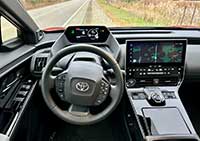
Step inside, and the cabin feels modern and functional. A large centre screen, wide console and well-spaced controls make it easy to settle in.
The dash has textured panels, visibility is excellent, and there’s more than enough legroom. Seats are supportive and well-suited for long road trips.
At highway speeds, however, more wind and road noise creeps in than in rivals like the Hyundai Ioniq 5 or Kia EV6.
That said, the interior has some unique design elements worth noting. Toyota has moved the speedometer and other gauges to the top of the dashboard, near the base of the windshield. It’s meant to replace the need for a projected heads-up display. It takes a bit of adjustment but works well enough once your eyes adapt.
The good news: Toyota hasn’t ditched buttons. The cabin includes large, clearly marked physical controls, a welcome break from the all-touchscreen trend. Storage space is generous, with 784 litres of cargo room in the back.
Of course, all of this depends on what you’re willing to spend. The base LE model starts at $46,515. My fully loaded tester came in at $65,808, putting it up against the Volkswagen ID.4, Nissan Ariya and Hyundai Ioniq 5. In that crowd, Toyota’s biggest edge is its reputation for long-term reliability.
Charging at home is straightforward if you install a Level 2 charger. Public charging networks in Canada are growing, but access still varies—especially outside major urban centres.
With its distinctive looks, practical range and comfortable interior, the bZ4X is a promising entry into the EV market. But limited availability and some unconventional design choices may hold it back—at least until Toyota ramps up supply.
Our Verdict
If you trust Toyota and are ready to go electric, and can find one, the bZ4X deserves a look. It’s well built, easy to live with and stylish enough to stand out. But if you’re after high performance or long-distance driving, other EVs may fit the bill better.
Dale Johnson is an award-winning author, broadcaster and journalist who has worked in TV, radio, print and online. While the manufacturer provided Dale with a vehicle to test drive, the content of this review was not reviewed or accepted by the manufacturer.
Explore more on Toyota, Automotive technology, 2025 car review
The views, opinions, and positions expressed by our columnists and contributors are solely their own and do not necessarily reflect those of our publication.
Troy Media empowers Canadian community news outlets by providing independent, insightful analysis and commentary. Our mission is to support local media in helping Canadians stay informed and engaged by delivering reliable content that strengthens community connections and deepens understanding across the country.

