
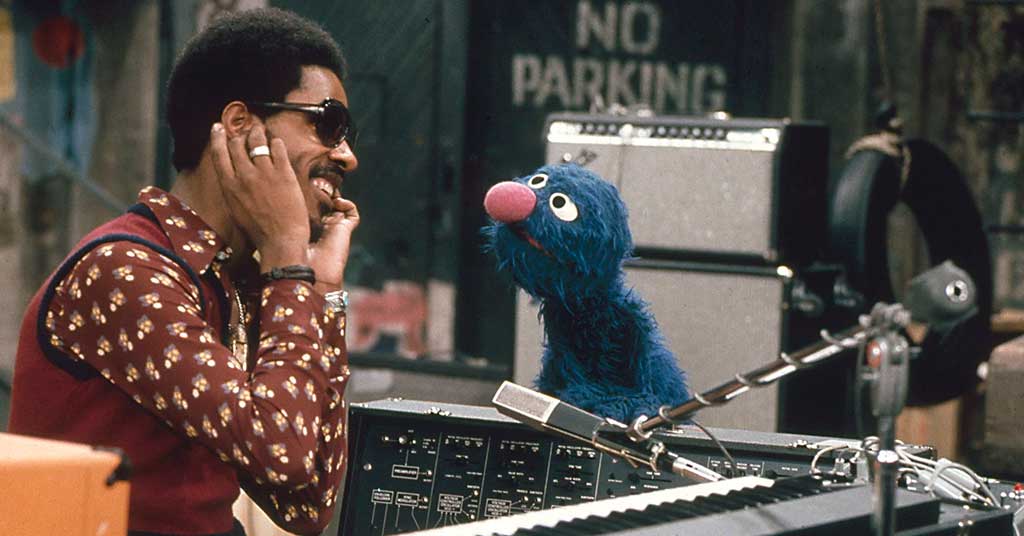
His 1973 performance of “Superstition” showed how music could unite children and parents alike
The Old Farmer’s Almanac noted the first day of summer, or the astronomical summer solstice, in the Northern Hemisphere occurred on Sunday, June 21. (Which also coincidentally happened to be Father’s Day in Canada.)
Canadians are looking forward to some nice weather after an unusually harsh winter. School is out for the kids. Vacations and day trips are being scheduled. Barbecues at night. Family and friends coming over for a meal, a few drinks and some hearty laughs.
I’ll be partaking in these activities, too. The summer months also give me an opportunity to change things up and write some fun, non-political columns.
Let’s explore an amusing topic that can be written as a mathematical equation emphasizing one letter of the alphabet. What would that be? Summer Solstice + Stevie + Sesame Street = Superstition.
This refers to Stevie Wonder’s memorable appearance on Sesame Street on episode 0514, which aired on April 12, 1973. (It was produced on January 9 of that year.) He was 22 years old, and had already been an established musician for half of his life. His first number one hit was “Fingertips-Part 2” in 1963 when he was known as “Little” Stevie Wonder. He also had several number one R&B hits like “Uptight (Everything’s Alright)” in 1965 and “Signed, Sealed, Delivered I’m Yours” in 1970.
Wonder’s already-successful career exploded after the 1972 release of one of his classic albums, Talking Book. His massive hit, “Superstition,” rocketed to number one and earned him Grammy Awards for Best R&B Vocal Performance, Male and Best Rhythm and Blues Song. Another song from that album, “You Are the Sunshine of My Life,” also went to number one and earned him an additional Grammy for Best Pop Vocal Performance, Male. Both songs were later inducted into the Grammy Hall of Fame.
The talented musician was on top of the world. He would have been in high demand for any medium you can think of. One of those destinations turned out to be Sesame Street.
The long-running educational children’s program was still in its infancy when Wonder agreed to appear on it. Sesame Street’s first episode aired on Nov. 10, 1969. His episode would be seen in the latter stages of the fourth season. Although he could have chosen to appear just about anywhere, it was clear why he had picked this specific show.
Sesame Street’s first episode earned a 3.3 Nielsen rating, or 1.9 million U.S. households, according to a Dec. 24, 1969, article in Variety. By February 1973, or two months before Wonder’s appearance, Robert W. Morrow’s Sesame Street and the Reform of Children’s Television noted “the show’s weekly cumulative audience was 8.2 per cent, reaching the same average audience as a typical Saturday morning children’s show.” Even if he was paid nothing more than scale for this appearance—and there’s no existing record or public statement related to what he received—these are the sort of viewership numbers that any public figure would want to take advantage of.
Wonder also surely realized his music would have long-term appeal with this younger demographic as it already likely had with some of their parents. Sesame Street’s multiracial audience was a natural fit for his musical style, which was a combination of soul, R&B, pop, funk and more. The show’s educational component may have had some personal appeal. And if his appearance on the PBS mainstay was deemed to be a critical success, it would confirm he had chosen wisely.
That’s exactly what happened.
Wonder played a magnificent live version of “Superstition” with his group that lasted six minutes and 48 seconds. This was almost unheard of on children’s programming or otherwise—and still is to this day. He performed an original song, “1-2-3 Sesame Street,” in which he used a talk box device that he had worked with before. There were three short scenes with Grover, the popular Muppet character, in which they tried out different musical techniques—loud/soft, short/long notes, and even a bit of scat singing.
The episode was a musical triumph that left vivid, lasting memories for many young viewers. “It was a glimpse into the utopic possibility of a place, neither child- nor adult-oriented but simply human,” Dana Stevens wrote for Slate on Dec. 21, 2016, “where great musicians could play their hearts out in the public square and everyone in earshot would be free to grab a maraca, climb a fire escape, and dance like a maniac.”
It also had a significant impact on Sonia Manzano, who played Maria on Sesame Street. “The whole studio rocked out and it was great because, white people, black people, young people, old people—everybody was on the same page for that two minutes that he sang and that really stands out,” she told NPR on Aug. 24, 2015, “It was a moment of clarity, I think that you know, we started this show, we thought we were going to end racism, we were going to close the education gap…We had big dreams! And moments like Stevie being on the show gave us a glimpse of the way things could be.”
When Stevie Wonder sang “Superstition” on Sesame Street, he gave millions of children and their parents a sense of joy, pride and hope for the future. That’s a great way to start off the summer solstice, courtesy of the letter “S.”
Michael Taube is a political commentator, Troy Media syndicated columnist and former speechwriter for Prime Minister Stephen Harper. He holds a master’s degree in comparative politics from the London School of Economics, lending academic rigour to his political insights.
Explore more on Culture, Children’s programs
The views, opinions, and positions expressed by our columnists and contributors are solely their own and do not necessarily reflect those of our publication.
Troy Media empowers Canadian community news outlets by providing independent, insightful analysis and commentary. Our mission is to support local media in helping Canadians stay informed and engaged by delivering reliable content that strengthens community connections and deepens understanding across the country.

